



DAVID OISTRAKH Prokofiev & Shostakovich
Violin Concertos
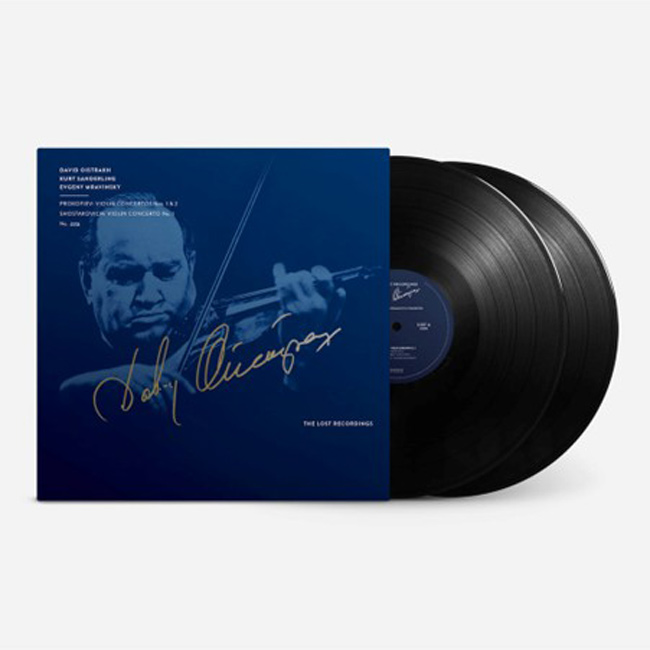
Available in two formats
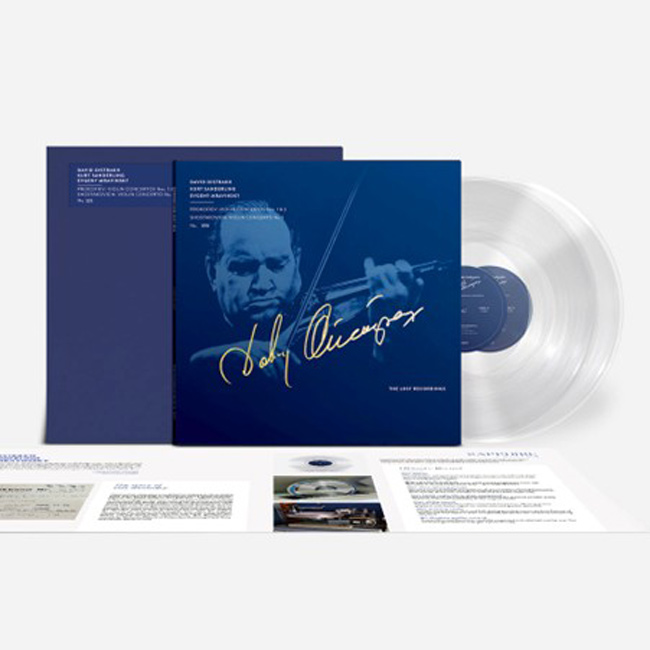
2LP 200g 33RPM Sapphire Edition
Strictly Limited to 500 Hand-Numbered Copies
or
2LP 180g First Edition Limited to 3,000 Copies
The Lost Recordings found the original tapes of Prokofiev’s two violin concertos in Potsdam.
The Berliner Sinfonie-Orchester was conducted by Kurt Sanderling.
Concerto No. 2, recorded in 1965, has never before been released.
Shostakovich’s Concerto No. 1, played by Oistrakh at the very peak of his virtuosity under the baton of the great Yevgeny Mravinsky, has never before been released on vinyl.
Kurt Sanderling, at the helm of the Berliner Sinfonie-Orchester, conducted Prokofiev’s two concertos in public.
The first was performed on 19 April 1971 at the Deutsche Staatsoper in Berlin and the second, on 8 March 1965 at the Metropol Theatre in Berlin.
Sanderling was admired for his musical integrity and powerful conducting. In 1960, after a career marred by various tragic events, he found himself in East Germany.
The Jewish conductor fled Germany in 1936 when the Nuremberg Race Laws were enacted, taking refuge first in Moscow and then in Leningrad as assistant to Yevgeny Mravinsky. Oistrakh and Sanderling had known each other for decades when these recordings were made; both their personal and professional bonds were tight.
Concerto No. 1 by Prokofiev is one of the most innovative works of the twentieth century.
It was composed between 1915 and 1917 and premiered in Paris in 1923.
The Andantino unfurls darkly, with a nostalgic violin leading in an ethereal, almost unreal theme.
Prokofiev said that this movement should be played “as if someone had to be convinced of something”.
Oistrakh, like an elf emerging from an extremely dense, dark forest, plays on the entire range of sounds – passionate, impatient, regal and spirited all at once.
The second movement, the Scherzo vivacissimo, can be considered the wild element of this concerto. It is an ingenious whirlwind involving violin virtuosity that Oistrakh carries off effortlessly.
The third and last movement is both lyrical and intense.
The violin alternates between two roles, that of soloist and that of accompanist. Oistrakh’s playing, devoid of mannerisms, is pure yet sensual, its earthbound quality essential to contain the orchestra that gradually fades away gently, as otherworldly as the first movement.
Concerto No. 2, first performed in 1935, is quite different.
It is not only more classical than the first but also more dramatic.
The violin, alone, introduces the sombre, lyrical theme of the movement inspired by traditional Russian folklore.
Oistrakh seems to explore the very depths of his innermost soul.
Long, lyrical phrases are interrupted by more rhythmical rises and falls in pitch.
The movement ends with pizzicati that we might be tempted to consider mischievous, or even frightening, but that leave us in anticipation.
The next movement, Andante assai, is some of the finest musical writing for the violin. A painful, tormented meditation, its intense surges nevertheless remain earthbound as they implore the heavens.
Here, Oistrakh is masterful. From his violin, from his very person, so closely bound, he brings out an almost mystical fervour, with a timelessness entwined with harmonious purity that few musicians have achieved with such grace.
The finale, Allegro ben marcato, returns to the more ironic style of which Prokofiev was so fond. In this frenzied, flamboyant dance with its Spanish overtones – the work premiered in Madrid – the composer surprises us with castanets.
Oistrakh and Sanderling make the most of these multi-coloured, sparkling inflections that were enthusiastically acclaimed by the audience.
On 25 May 1956, Yevgeny Mravinsky was conducting the Leningrad Philharmonic Orchestra at the Berlin Staatsoper.
Since 1938, he had led the orchestra to a pinnacle in their interpretation of mainly Russian composers, such as Tchaikovsky and Shostakovich. His style was immediately recognisable.
With a volcanic eruption of sound, he bade the orchestra to sweep along everything in its path.
It was the very same orchestra that had first performed the concerto one year previously.
Subjected to censorship by the Department of Propaganda, the work had been hidden since its composition in 1948. Oistrakh himself had made modifications that the composer welcomed.
In short, it was the concerto of a combat, and no one better than Oistrakh himself could speak of it.
“The first movement, the Nocturne, is a world of deep reflection.
I would call it a cancellation of feelings.
Here, there is no overt expression of suffering; everything seems to be hidden within”.
The violin’s line expresses distress.
It is gloomy and introspective, and in the background are hints of a Dies Irae that might have been inspired by Mozart.
“Devilish” is the word Oistrakh uses to describe the second movement.
And indeed he rushes into a nervous Allegro, borne dynamically along by Mravinsky’s orchestra.
The scale of the Andante is monumental, similar in several respects to the first movement of Beethoven’s Fifth Symphony.
The violin is omnipresent, in dialogue or opposition with the different sections of the orchestra.
Oistrakh is calm and imperial, in complete control of the situation until the beginning of the transcendent cadence.
The rests take on as much expressivity as the notes, if not more.
We forget the dazzling technique of the violinist’s left hand to focus on the drama.
Then, quite exceptionally, there is a fourth movement.
The finale is slapstick, wildly burlesque, and Oistrakh and Mravinksy bring it to its climax.
The angel flew over these concertos.
But it is a terrestrial angel, one that no wind can deviate from its course.
This angel is sometimes harsh, sometimes gentle, but always powerful and moving.
This is an angel whose only god is music and whose only companion is the violin.
“However hard I try, I can’t recall ever having been without a violin during my childhood.”
This might prompt us to respond, “However hard we try, we cannot imagine the violin without recalling the heavenly playing and sound of David Oistrakh.”
Musicians:
David Oistrakh, violin
Kurt Sanderling, conductor
Berliner Sinfonie-Orchester
**Evgeny Mravinsky, conductor
**Leningrad Philharmonic Orchestra
Track List (Both Formats): DAVID OISTRAKH Prokofiev & Shostakovich
RECORD 1
1. Prokofiev: Violin Concerto No. 1 in D Major, Op. 19
i. Andantino
ii. Scherzo: Vivacissimo
111. Moderato: Allegro moderato
2. Prokofiev: Violin Concerto No. 2 in G minor, Op. 63*
i.Allegro moderato
ii.Andante assai
iii. Allegro, ben marcato
RECORD 2
3. Shostakovich: VIolin Concerto No. 1 in A minor, Op. 77**
i.Nocturne: Moderato
ii.Scherzo: Allegro
iii.Passacaglia: Andante-Cadenza
iv. Burlesque: Allegro con brio-Presto