

AudioQuest Niagara Power
AudioQuest is proud to introduce their Niagara 7000 Low-Z Power Noise-Dissipation System, a complete rethinking of AC power filtration, designed by one of the field’s foremost experts, Garth Powell.

As with every AQ product before, and more recently their DragonFly USB DAC and NightHawk headphones, they would not have entered this field if they didn’t think they had something special and significant to offer.
In Niagara 7000, they believe they created a product that revolutionises the art and science of AC power—a product that will inspire audio/video enthusiasts and help to create an even more immersive, emotionally compelling experience.
In designing Niagara 7000, they aimed to successfully address problems that prevent today’s audio/video components from achieving their potential.
Due to the great increase in airborne and AC-line-transmitted radio signals, combined with overtaxed utility lines and the ever-increasing demands from high-definition audio/video components, a complete rethinking of AC power technology is needed to provide our A/V systems with the power required to fulfill their potential.
Further, today’s power amplifiers are being taxed for instantaneous peak-current demand, even when they’re driven at modest volumes.
Although they have seen a substantial increase in dynamic range from much of our audio software, the loudspeakers we employ to reproduce them are often no more efficient than they were 50 years ago.
This places great demands on an amplifier’s power supply, as well as the source AC power supplying it.
In their efforts to properly accommodate the promise of today’s ever-increasing bandwidth and dynamic range, the Niagara 7000 affords extremely low system noise and provides superior current delivery across a very wide range of frequencies.
Through differential sample tests and spectrum analysis, it can be proven that up to a third of a high-resolution (low-level) audio signal can be lost, masked, or highly distorted by the vast levels of noise riding along the AC power lines that feed our components.
This noise couples with the signal circuitry as current noise and through AC ground, permanently distorting and/or masking the source signal.
Our systems’ sensitive components need better alternating current.
They realise that true audio/video optimisation is never a matter of any one secret or exotic circuit. When it comes to noise dissipation for AC power, many approaches can yield meaningful results.
However, these approaches may also impart ringing, current compression, and non-linear distortions that can render the cure worse than the disease.
While there currently exist a number of AC power conditioners, isolation transformers, regeneration amplifiers, and battery back-up system topologies, Niagara 7000 takes a holistic, science-based approach to AC power technology and represents a comprehensive solution to the ever-increasing noise that plagues our power lines.
In the Niagara 7000, you’ll find optimised radio-frequency lead directionality, run-in capacitor forming technologies developed by Jet Propulsion Laboratories and NASA, and AC inlet and outlet contacts with heavy silver plating over extreme-purity copper assuring the tightest grip possible.
The Niagara 7000 uses their patented AC Ground Noise-Dissipation System, the world’s first Dielectric-Biased AC Isolation Transformers, and the widest bandwidth-linearised noise-dissipation circuit in the industry.
Their unique passive/active Transient Power Correction Circuit features an instantaneous current reservoir of over 90 amps peak, specifically designed for today’s current-starved power amplifiers.
Most AC power products featuring “high-current outlets” merely minimise current compression; the Niagara 7000 corrects it.
With an AudioQuest Niagara 7000, music lovers can finally experience the clarity, dimensionality, frequency extension, dynamic contrast, and grip their A/V systems have been capable of delivering—if only the power had been right!
Niagara 1000
Niagara 1000 brings the benefits of highly optimised power management to far more music lovers. Image shown U.S. Version
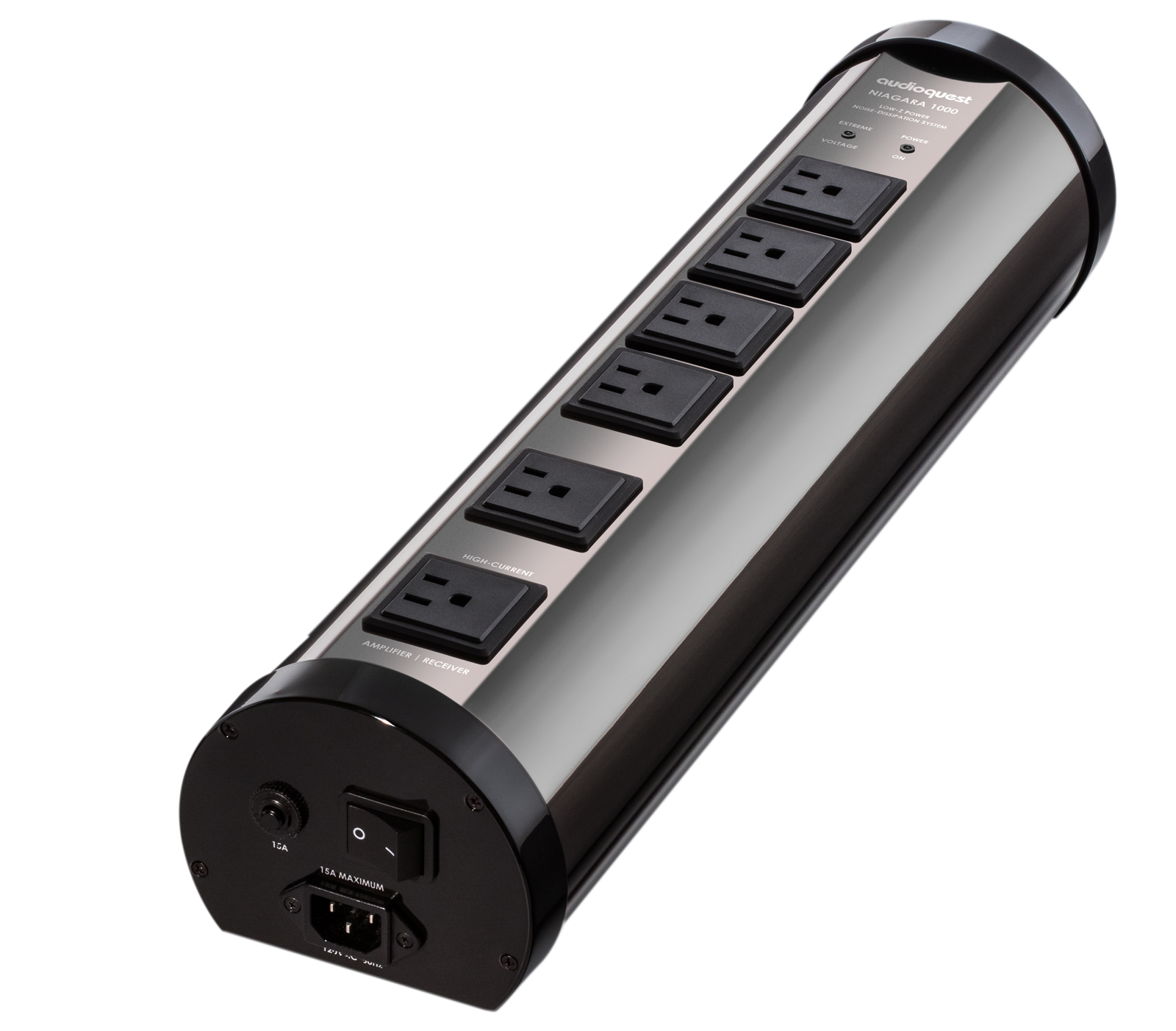
Designed by Garth Powell, the Niagara 1000 embodies the very same design philosophy and incorporates the same patented technology found in its larger sibling, the Niagara 7000, but packs it into a smaller, sleeker enclosure—at a fraction of the price.
Much like the Niagara 7000, the Niagara 1000 uses ultra-low resistance solid-core wiring optimised for low-noise directionality, capacitor forming technologies that vastly improve linearity and minimise distortion, and low impedance AC inlet and outlet contacts with heavy silver plating over high-purity Beryllium Copper for superior noise dissipation.
Similarly, Niagara 1000 features their non-sacrificial surge protection, Zero Ground-Contamination Technology, and over-voltage shutdown, ensuring that your A/V systems are thoroughly protected from AC surges and spikes.
While the Niagara 1000 lacks the 7000’s sophisticated Transient Power Correction and Dielectric-Biased AC Isolation Transformers, it does employ their patented Ground-Noise Dissipation System and Ultra-Linear Noise-Dissipation Technology.
And, whereas the Niagara 7000 has 11 UK. AC outlets, the Niagara 1000 fits six high-performance outlets into its sleek chassis. In addition, input current maximum capacity—20 amps RMS in the Niagara 7000—is 15 amps RMS in the 1000.
Of course, the biggest differences between the 7000 and 1000 are also the most obvious: size, shape, and weight.
The Niagara 7000 can be rack-mounted and measures 15.5” W x 5.24” H x 17.2” D and weighs an impressive 36.7Kg.
The Niagara 1000, however, is designed to be placed on a floor or atop a rack, beside or behind a hi-fi system, measures 4.75” W x 4.0” H x 20.0” D, and weighs a much more manageable 2.49Kg.